
CARPET BEETLES
Varied Carpet Beetle (Anthrenus verbasci)
The most common carpet beetle species in the UK. Adults are small round beetles, 2-3mm long. Larvae, often referred to as woolly bears, grow to 5mm. In summer, adults are found on plants outside. After mating, the females fly through open windows into buildings to lay eggs. They will also infest bird nests.
The larvae are voracious feeders making small, neat holes in the materials under attack. They will attack fur, feathers, taxidermy and wool textiles. Most larval activity takes place in dark, undisturbed locations. They can move long distances in search of food.
 Varied Carpet Beetle
Adults are small round beetles, 2-3mm long. Larvae, often referred to as woolly bears, grow to 5mm.
In summer, adults are found on plants outside. After mating, the females fly through open windows into buildings to lay eggs. They will also infest bird nests.
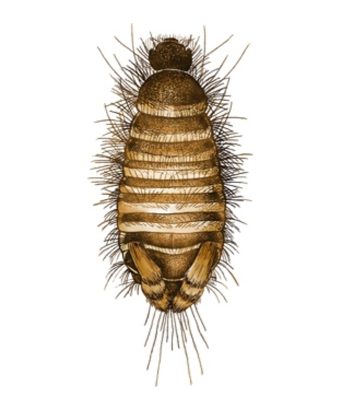 Varied Carpet Beetle Larvae
The larvae are voracious feeders making small, neat holes in the materials under attack.
They will attack fur, feathers, taxidermy and wool textiles. Most larval activity takes place in dark, undisturbed locations. They can move long distances in search of food.
2 Spot Carpet Beetle or Fur Beetle, (Attagenus pellio)
The most common Attagenus species these are difficult to control as the larvae can forage widely. Adults are black, oval in shape, 4-6mm in length and have a characteristic white spot on each wing case. Larvae are up to 10mm in length and carrot shaped.
Adults are active flyers and are often found on windowsills. Adult females lay batches of eggs secreted in cracks and crevices in dark, undisturbed areas directly on the food material. Larvae will attack protein-rich materials including, feathers, fur, mammal and bird skins. Often the first sign of an infestation will be the empty, striped cast skins left behind on infested material due to pupation.
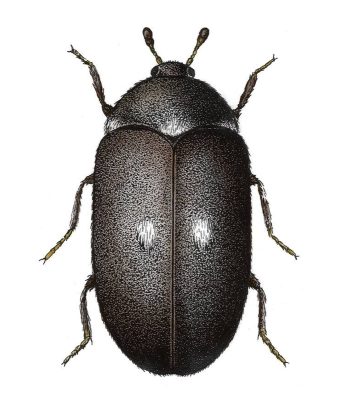 2 Spot Carpet Beetle
Adults are black, oval in shape, 4-6mm in length and have a characteristic white spot on each wing case.
Adults are active flyers and are often found on windowsills.
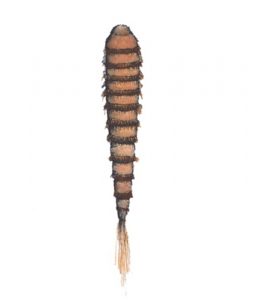 2 Spot Carpet Beetle Larvae
Larvae are up to 10mm in length and carrot shaped.
Larvae will attack protein-rich materials including, feathers, fur, mammal and bird skins.
Guernsey Carpet Beetle (Anthrenus sarnicus)
These small (2-4mm) round beetles are covered with grey and gold scales. Larvae are short and fat with bands of orange brown hairs. They are extremely difficult to distinguish from the closely related Varied Carpet Beetle. Adult beetles fly when it is warm and may frequently be found on windowsills. The larvae usually take 1 year to complete their growth. The larvae wander but are often in dark and hidden places where dirt accumulates.
They will feed on dead insects, especially flies, and are also found in natural situations such as birds’ nests and animal burrows.
 Guernsey Carpet Beetle
These small (2-4mm) round beetles are covered with grey and gold scales.
Adult beetles fly when it is warm and may frequently be found on windowsills.
 Guernsey Carpet Beetle Larvae
Larvae are short and fat with bands of orange brown hairs.
The larvae wander but are often in dark and hidden places where dirt accumulates. They will feed on dead insects, especially flies.
Dark or Small Carpet Beetle (Anthrenus fuscus)
Adults are similar to the above, smaller at 1.7 – 2.8 mm and darker. Adult is smaller and much darker than the Varied Carpet Beetle and Guernsey Carpet beetle. During the summer, the adult beetles feed on pollen and nectar of plants such as Umbellifers and Lily of the Valley.
After mating, the females can fly through open windows into buildings to lay eggs. Common egg laying sites are on material of animal origins such as wool carpets and clothing, animal furs etc.
 Dark Carpet Beetle
Adults are similar to the above, smaller at 1.7 – 2.8 mm and darker.
During the summer, the adult beetles feed on pollen and nectar of plants such as Umbellifers and Lily of the Valley.
 Dark Carpet Beetle Larvae
After mating, the females can fly through open windows into buildings to lay eggs.
Common egg laying sites are on material of animal origins such as wool carpets and clothing, animal furs etc.
And as always, if you have any questions, simply get in touch with us and we can give you advice based on our experience.
Here are some products that may interest you

“`